Home / Dog food / Best high-protein dog food
Definitive pick · updated 2026-07-12The Best High-Protein Dog Food
The verdict
The best high-protein dog food is Purina Pro Plan Sport 30/20. It's the high-protein formula with the strongest evidence — an AAFCO feeding trial (actually fed to dogs, not just formulated on paper) — it's grain-inclusive so it sidesteps the grain-free/DCM question, it's recall-clean, and at $/1,000 kcal it's the best value here (34.1% protein, dry-matter). Below: why, plus the number the shelf hides — where the protein actually comes from.
Purina Pro Plan Sport Performance 30/20 Chicken & Rice Formula Dog Food
The high-protein food with the strongest evidence — and the best value. The only kind of proof that counts — a real feeding trial — plus a grain-inclusive recipe, a recall-clean record, and the lowest cost per 1,000 kcal on this page.
Buy links are affiliate links — as an Amazon Associate we earn from qualifying purchases, and it never changes our pick or any number on this page (every figure is computed the same way for every food).
Amazon prices as of 2026-10-18. Product prices and availability are accurate as of the date/time indicated and are subject to change. Any price and availability information displayed on Amazon at the time of purchase will apply to the purchase of this product.
Read this first: The protein percentage on the bag is measured as-fed — it includes the food's moisture, so it isn't comparable across foods. We rank on a dry-matter basis instead. And a big protein number doesn't tell you where the protein comes from: peas, pea protein, and corn gluten meal are plant concentrates that lift the figure without adding meat. High protein is also usually high calorie — great for an active dog, a weight-gain risk for a couch-potato one. Match it to your dog.
Why it wins
The whole case, in five checks
Not an opinion score — each row is a verifiable fact from the label or our computed metrics.
Only about 1 in 5 dog foods carries the stronger feeding-trial AAFCO statement; almost none at this protein level do. Protein and fat are computed on a dry-matter basis from each label. See our methodology.
The data
Ranked by real protein — and the column the shelf hides: where it comes from
Sorted by dry-matter protein (the comparable number). "Protein source" reads the ingredient order: is the protein from meat, or lifted by plant concentrates like pea protein and corn gluten meal? Winner row highlighted.
| Food | Protein (DM) | As-fed | Protein source | AAFCO tier | Cost/1,000 kcal |
|---|---|---|---|---|---|
| Orijen OriginalHighest animal protein | 43.2% | 38% | All animal First 11 ingredients all animal | Formulated | $2.42 |
| Wellness CORE Natural Grain Free Dry Dog Food, Original Turkey & Chicken RecipeFeeding-trial value | 37.8% | 34% | Mostly animal Turkey & turkey meal first | Feeding trial | $1.37 |
| Blue Buffalo BLUE Wilderness High Protein Adult Dog Grain-Free Chicken RecipeThe “high protein” that leans on peas | 37.8% | 34% | Plant-padded Peas + Pea Protein at #3 and #4 | Formulated | — |
| Purina Pro Plan Sport Performance 30/20 Chicken & Rice Formula Dog FoodOur pick | 34.1% | 30% | Mostly animal Chicken first — corn gluten meal #2 | Feeding trial | — |
The takeaway: the highest number (Orijen, 43% DM) is all animal protein; the familiar "high protein" bag (Blue Buffalo Wilderness) reaches 38% partly with pea protein. Our winner isn't the biggest number — it's the one that's proven, safe, and affordable. "As-fed" is the bag's figure; "DM" removes moisture so foods are comparable.
The runners-up
Three more — the purest animal protein, a proven-value pick, and a cautionary label
Each is a real high-protein food; the role tag says the job it does. "The catch" is where the tradeoff lives.
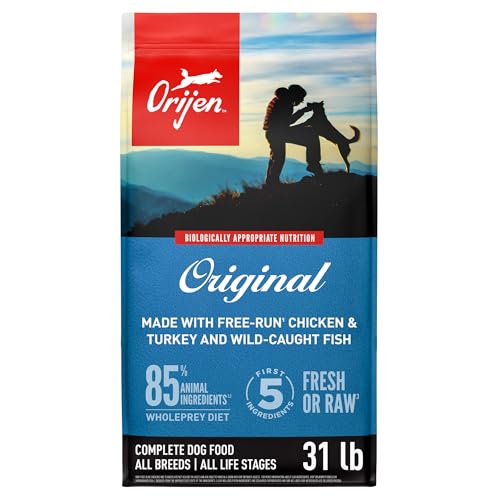
Orijen Original
The highest protein here — and it all comes from meat.
If you want the most protein, and you want it from animals rather than plants, this is it: 43% protein on a dry-matter basis, and the first eleven ingredients are all animal — chicken, turkey, salmon, herring, and organs — before a single plant appears. No pea or corn protein padding the number. Brand has never been recalled.
The catchIt's grain-free, and Orijen was among the 16 brands named in the FDA's (still-unresolved) DCM report tally — largely because it's a popular grain-free brand. Its protein is animal-first, but legumes do appear lower in the list. If grain-free matters to you, read our grain-free guide first. It's also the priciest here, and formulated rather than feeding-trial.
cost / 1,000 kcal$2.42
- Protein (DM)
- 43.2%
- Source
- All animal
- AAFCO
- Formulated
- Verified bag
- 31 lb

Wellness CORE Natural Grain Free Dry Dog Food, Original Turkey & Chicken Recipe
The other feeding-trial pick — high protein, everyday price.
Like our top pick, this one is feeding-trial substantiated (proven on real dogs), which almost no high-protein food is. It runs a bit higher on protein (38% DM) at a lower price than the premium options. Turkey and turkey meal lead; potatoes and lentils follow, so it's mostly — not entirely — animal protein.
The catchIt's grain-free with lentils (legume load 2) — lower than the pea-heavy options, but worth knowing given the open DCM question.
cost / 1,000 kcal$1.37
- Protein (DM)
- 37.8%
- Source
- Mostly animal
- AAFCO
- Feeding trial
- Verified bag
- 35 lb
coming
Blue Buffalo BLUE Wilderness High Protein Adult Dog Grain-Free Chicken Recipe
A familiar “high protein” bag — partly powered by plants.
It's the recognizable high-protein grain-free bag, and its 38% dry-matter protein looks great on the shelf. We include it to show how the number is built: chicken is first, but Peas and Pea Protein sit at #3 and #4 — plant-protein concentrates that lift the crude-protein figure. Some of the “high protein” here comes from legumes, not meat.
The catchPea protein padding means the crude-protein number overstates the animal protein — and the legume load (3) is the pattern the FDA's DCM inquiry centers on.
retailsee label
- Protein (DM)
- 37.8%
- Source
- Plant-padded
- AAFCO
- Formulated
Amazonnot matched yet
Composition and price are pulled live from our verified corpus and were current on 2026-07-12.
How we picked
The method — a rubric first, then a reconciliation
Nothing here is an opinion score.
Step 1 — pass the rubric. Every candidate is genuinely high protein (well above the ~25% dry-matter of a typical adult food), leads with a named animal protein, and discloses enough label data to compute dry-matter protein.
Step 2 — reconcile on evidence and safety, not just the number. A high crude-protein figure is easy to print. What's hard is proving the food works (an AAFCO feeding trial) and is safe (recall-clean, no unresolved DCM-pattern concern). Purina Pro Plan Sport 30/20 wins because it's the rare high-protein food that clears both — grain-inclusive, feeding-trial substantiated, recall-clean — and it's the cheapest per 1,000 kcal here. If you specifically want the highest, all-animal protein, Orijen is the pick (with the grain-free caveat).
Why we show the pea-padded pick. We include a "high protein" bag whose number is partly plant protein on purpose — because the crude-protein figure alone can't tell you whether the protein is meat or peas. Reading the ingredient order can, which is exactly what our data does.
1. Genuinely high dry-matter protein, named protein first
2. AAFCO feeding-trial evidence (proven on dogs)
3. Safe: recall-clean, no DCM-pattern concern
4. Protein from animals, not plant padding
5. Reasonable cost per 1,000 kcal
The why
Reading a high-protein label without getting fooled
Two numbers the shelf hides — and one safety habit that matters.
As-fed vs dry-matter. The "guaranteed analysis" protein on the bag is measured with the food's moisture still in it. A dry food at 30% and a canned food at 10% can carry similar real protein once you take the water out. Comparing on a dry-matter basis removes the moisture so foods line up honestly — we compute it for every food.
Where the protein comes from. Crude protein counts nitrogen, and plants have nitrogen too. Pea protein, potato protein, and corn gluten meal are concentrates that lift the number without adding meat. That's why we read the ingredient order: Orijen's first eleven ingredients are animal; a pea-padded "high protein" bag puts peas near the top.
Vet the recalls. The two cheapest ultra-high-protein bags in our data — Victor Nutra Pro (42% DM) and Diamond Naturals Extreme Athlete (36% DM) — both carry Salmonella recalls (Victor in 2023; Diamond's Gaston plant in 2012). A big protein number at a low price is worthless if the food is recalled. We web-verify every winner's recall status for exactly this reason.
• Compare dry-matter, not the bag's as-fed number
• Animal protein > pea/corn protein padding
• Feeding-trial > formulated-on-paper
• High protein is usually high calorie — match activity
• Healthy dogs: protein doesn't harm kidneys
• Always check the recall record
Common questions
Best high-protein dog food, answered
What is the best high-protein dog food?
Our pick is Purina Pro Plan Sport 30/20: the high-protein food with the strongest evidence (an AAFCO feeding trial), grain-inclusive so it sidesteps the DCM question, recall-clean, and the best value here. If you want the highest, purest animal protein, Orijen Original hits 43% dry-matter protein with its first 11 ingredients all animal (though it's grain-free).
How do I compare protein between dog foods?
Compare on a dry-matter basis, not the bag's number. The bag lists protein as-fed, which includes moisture — so a dry food at 30% and a wet food at 10% can have similar real protein once you remove water. Also look at where the protein comes from: peas, pea protein, and corn gluten meal are plant concentrates that raise the number without adding meat. We compute dry-matter protein and read the ingredient order for every food.
Is high-protein dog food better?
Not automatically. Active dogs generally do well on higher protein, and protein preserves muscle — but "high protein" formulas are often also high in fat and calories, which can drive weight gain in a less-active dog. Match protein and calories to your dog's activity, and read the ingredient order to be sure the protein is meat, not plant padding.
Does high protein cause kidney problems in healthy dogs?
In healthy dogs, current evidence does not show that higher dietary protein causes kidney disease. Protein restriction is a tool for dogs that already have kidney disease, not a preventive measure for healthy ones. If your dog has diagnosed kidney or liver disease, protein level should be set by your veterinarian.