Home / Dog food / Pedigree / PEDIGREE® Tender Bites Dry Dog Food – Chicken & Steak
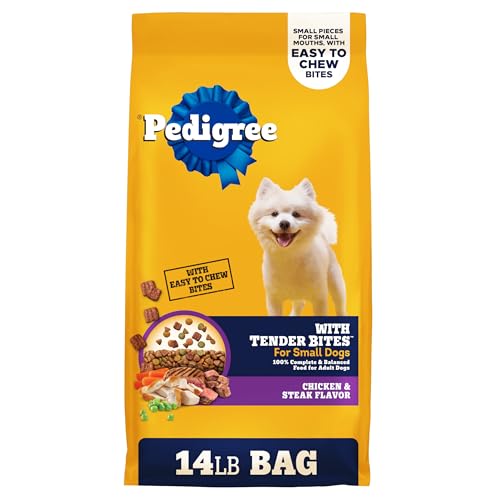 official product image via Amazon
Pedigree · brand facts & recall history →
PEDIGREE® Tender Bites Dry Dog Food – Chicken & Steak
A dry food that's cheaper per calorie than 93% of the dry foods we've priced and denser than 14% (you feed fewer cups) — $0.94 a day for your 40-lb adult dog.
THE FACTS, ONE SENTENCE — data as JSON · reference dog 40 lb · updated 2026-10-18
The evidence
The Verified Label
Every food on this site gets this exact panel — same fields, same order, sourced from the official label — so brands finally become comparable. Dots show where this food sits among all 494 dry foods we've verified.
verified 2026-10-18
Composition — dry-matter basis
why dry matter
Calories & cost — for your 40-lb adult dog
Cost per 1,000 kcal: $0.96 — cheaper than 93% of the 360 dry foods we've priced (median $1.93). Serving math uses standard veterinary energy formulas — see the formula.
Standards & ingredients
what this means
why unknown
Safety
Source: official label source (official)· price: Amazon, 2026-10-18 · anchors: 494 verified dry dog foods (360 priced) · how to read this label
The fit
For your dog, specifically
Checked for a 40-lb adult with a sensitive stomach — the same published criteria our finder uses. Change your dog above and these update.
The source material
The full ingredient list
Every flag above is computed from this list. Why order is by pre-cooking weight, and how splitting bends it →
Ground Whole Grain Corn, Chicken By-Product Meal (Source of Glucosamine & Chondroitin Sulfate), Corn Gluten Meal, Animal Fat (Source of Omega 6 Fatty Acids) [Preserved with BHA/Citric Acid], Soybean Meal, Meat and Bone Meal (Source of Calcium), Ground Whole Grain Wheat, Natural Flavor, Brewers Rice, Water, Glycerin, Chicken Meal, Salt, Sugar, Calcium Carbonate, Monocalcium Phosphate, Potassium Chloride, Choline Chloride, Phosphoric Acid, Dried Peas, Potassium Sorbate (preservative), DL-Methionine, Natural Grilled Steak Flavor, Vitamin E Supplement, Zinc Sulfate, BHA (preservative), Citric Acid (preservative), Red 40, L-Tryptophan, Yellow 6, Dried Carrots, Niacin Supplement [Vitamin B3], Blue 2, Yellow 5, D-Calcium Pantothenate [Source of Vitamin B5], Copper Sulfate, Sodium Selenite, Potassium Iodide, Vitamin A Supplement, Riboflavin Supplement [Vitamin B2], Vitamin B12 Supplement, Thiamine Mononitrate [Vitamin B1], Vitamin D3 Supplement, Pyridoxine Hydrochloride [Vitamin B6], Folic Acid
7 ingredients in this list are ones we hold sourced evidence on , and 2 of them are genuinely contested rather than merely unpopular online.
- BHA (butylated hydroxyanisole) · ingredient 4ContestedA synthetic antioxidant that slows fat oxidation (rancidity) in dry and fatty pet foods. Regulators permit it: EFSA judged BHA safe for most animal species up to 150 mg/kg complete feed, though it could not set a safe level for cats due to insufficient data.
- Peas · ingredient 20ContestedA pulse (legume) used in many grain-free foods as a plant protein and carbohydrate source. Peas are central to an open FDA investigation, begun in July 2018, into a possible link between diets high in peas, other pulses, and potatoes and canine dilated cardiomyopathy (DCM); 93% of reported products contained peas and/or lentils.
- Named Meat/Poultry Meal (e.g., Chicken Meal, Lamb Meal) · ingredient 12Well supportedA rendered, water- and fat-reduced concentrate from a named species (AAFCO, e.g., 'chicken meal'). Because most moisture is removed it is a dense protein source (poultry meals commonly around 57-69% crude protein) and it names the species for allergy avoidance.
- By-Product Meal (Meat / Poultry By-Product Meal) · ingredient 2NeutralA rendered concentrate made from clean, non-muscle parts of the carcass (organs, necks, feet, and similar), defined by AAFCO. It is more variable and lower-transparency than a named muscle meal, but it is not inherently unsafe or low-nutrition: controlled feeding trials in dogs report high protein digestibility (roughly 92-95%) for poultry by-product-based diets, and some by-product organs are nutrient-dense.
- Corn Gluten Meal · ingredient 3NeutralThe dried protein fraction of corn, used as a concentrated plant protein (roughly 60% protein) rather than a filler. Its amino acids are highly digestible in dogs (reported up to about 95%), though lysine is the first-limiting amino acid, so complete diets balance it with other protein sources.
- Meat and Bone Meal · ingredient 6NeutralA rendered concentrate of mammal tissue that also includes bone, giving it high mineral/ash content and lower crude protein (roughly 39-46%) than clean meat meals. Amino-acid availability varies substantially with rendering temperature and pressure — studies show good digestibility is achievable but not guaranteed across processing methods.
Nutritional twins
Cheaper close matches
Verified foods with a closely matching label at a meaningfully lower cost per 1,000 kcal.
Label-composition matches only: same species, form, and growth stage; same primary protein where both are known; grain-free preserved; protein within 4 points and fat within 4 points, and estimated carbs within 8 points, on a dry-matter basis. Not a medical or quality recommendation.
The maker
Who makes this — and how they back it up
The five questions the WSAVA nutrition guidelines tell you to ask a pet-food company. Every answer is sourced or marked as an undisclosed gap — never guessed. This is the "is it made competently?" axis that star-rating sites skip.
Mars Petcare owns/operates the Mattoon plant that produces Pedigree; Mars operates 14+ owned US plants.
source →Official brand FAQ explicitly states PhD nutritionists on staff; also states formulators include 'PhD/MS animal nutritionists, as well as PhD/MS food scientists.' No individual named, but credential class (PhD nutritionist) is stated. Backed by Mars' Waltham Petcare Science Institute.
source →No feeding-trial AAFCO statement found on the 70 labels we’ve verified for this brand, and no company-wide claim was found either. Most pet foods are only "formulated to meet" AAFCO profiles (a paper calculation) rather than fed to real animals in trials — this is common, not necessarily a red flag.
covers: finished-product testing, toxicological review of ingredients. Pedigree FAQ answering WSAVA's QC question.
source →666 PubMed papers (animal/pet filtered) list Waltham Petcare Science Institute (Mars Petcare) in an author address; we checked 200 and 200 really name the company. A floor, not a total.
source →Full company scorecard, sources, and every SKU we've verified for this brand: Pedigree brand page →