Home / Dog food / Blue Buffalo / BLUE Homestyle Recipe Adult Dog Turkey Meatloaf Dinner with Garden Vegetables
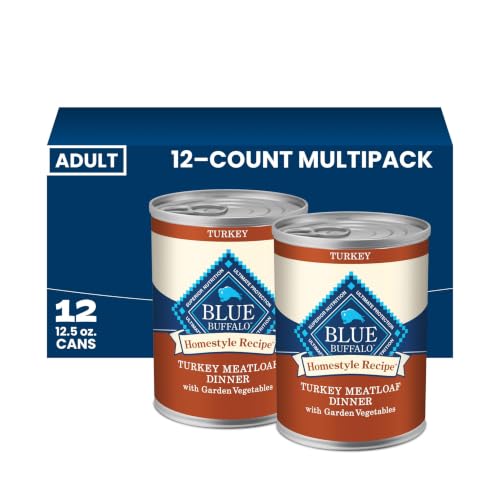 official product image via Amazon
Blue Buffalo · brand facts & recall history →
Blue Buffalo BLUE Homestyle Recipe Adult Dog Turkey Meatloaf Dinner with Garden Vegetables
A formulated-to-meet, turkey-first wet food — $6.64 a day for your 40-lb adult dog.
THE FACTS, ONE SENTENCE — data as JSON · reference dog 40 lb · updated 2026-10-18
The evidence
The Verified Label
Every food on this site gets this exact panel — same fields, same order, sourced from the official label — so brands finally become comparable. Corpus dot-anchors currently cover dry food only — this is a wet food, so anchors are omitted below rather than compared across forms.
verified 2026-10-18
Composition — dry-matter basis
why dry matter
Calories & cost — for your 40-lb adult dog
Cost per 1,000 kcal: $6.74. Our cost comparisons cover dry food only for now. Serving math uses standard veterinary energy formulas — see the formula.
Standards & ingredients
what this means
why unknown
Safety
Source: official label source (official)· price: Amazon, 2026-10-18 · anchors: 494 verified dry dog foods (360 priced) · how to read this label
The fit
For your dog, specifically
Checked for a 40-lb adult with a sensitive stomach — the same published criteria our finder uses. Change your dog above and these update.
The source material
The full ingredient list
Every flag above is computed from this list. Why order is by pre-cooking weight, and how splitting bends it →
Turkey, Turkey Broth, Turkey Liver, Carrots, Peas, Sweet Potatoes, Brown Rice, Barley, Oatmeal, Guar Gum, Potassium Chloride, Salt, Carrageenan, Blueberries, Cranberries, Flaxseed, Cassia Gum, Calcium Carbonate, Zinc Amino Acid Chelate, Iron Amino Acid Chelate, Choline Chloride, Vitamin E Supplement, Copper Amino Acid Chelate, Manganese Amino Acid Chelate, Sodium Selenite, Thiamine Mononitrate (Vitamin B1), Cobalt Amino Acid Chelate, Niacin Supplement (Vitamin B3), Calcium Pantothenate (Vitamin B5), Vitamin A Supplement, Riboflavin Supplement(Vitamin B2), Biotin (Vitamin B7), Vitamin B12 Supplement, Potassium Iodide, Pyridoxine Hydrochloride (Vitamin B6), Vitamin D3 Supplement, Folic Acid (Vitamin B9)
6 ingredients in this list are ones we hold sourced evidence on , and 2 of them are genuinely contested rather than merely unpopular online.
- Peas · ingredient 5ContestedA pulse (legume) used in many grain-free foods as a plant protein and carbohydrate source. Peas are central to an open FDA investigation, begun in July 2018, into a possible link between diets high in peas, other pulses, and potatoes and canine dilated cardiomyopathy (DCM); 93% of reported products contained peas and/or lentils.
- Carrageenan · ingredient 13Worth knowingA seaweed-derived (Chondrus crispus) thickener and gelling agent used mainly in some wet and canned dog foods. Low-molecular-weight 'degraded' carrageenan (poligeenan) is inflammatory in lab-animal studies and is not permitted as a food additive, but food-grade undegraded carrageenan (E 407) is authorized by regulators; EFSA's 2018 re-evaluation kept only a temporary group ADI of 75 mg/kg body weight per day pending better data, and its specific effect in dogs is unresolved.
- Sweet potato · ingredient 6NeutralA starchy root used as a carbohydrate source and a source of fiber and beta-carotene in grain-free foods (a vegetable, not a cereal grain). The FDA's 2018 DCM investigation grouped 'potatoes (including sweet potatoes)' within its ingredients of interest, but the reported cases were dominated by pulses and white potato, and evidence isolating sweet potato specifically is limited.
- Guar Gum · ingredient 10NeutralA soluble, viscous fiber from the guar bean used in small amounts to thicken and stabilize foods, mostly wet formulas. At higher dietary inclusion it can lower the digestibility of dry matter and protein in dogs, but it also produces metabolic effects such as reduced post-meal insulin and cholesterol; at the low levels used as a thickener these effects are minor.
- Flaxseed (ALA omega-3) · ingredient 16NeutralA plant source of the short-chain omega-3 ALA. Dogs convert ALA to the long-chain omega-3s inefficiently: a controlled feeding study (Dunbar 2010) found flaxseed raised serum EPA but produced no measurable DHA.
- Cassia Gum · ingredient 17NeutralA gelling agent made from the purified endosperm of Cassia seeds, used mainly in canned and wet foods. It is specifically authorized in the EU as a pet-food thickener: EFSA (2017) concluded that purified semi-refined cassia gum meeting the food-additive specification (under 0.5 mg anthraquinones/kg) is safe for dogs and cats up to the permitted feed level.
The maker
Who makes this — and how they back it up
The five questions the WSAVA nutrition guidelines tell you to ask a pet-food company. Every answer is sourced or marked as an undisclosed gap — never guessed. This is the "is it made competently?" axis that star-rating sites skip.
Same source also states: 'Blue Buffalo sources and produces everything from its own facilities or from partners across the United States.' Indicates a mix of own facilities plus third-party co-manufacturers.
source →Blue Buffalo's professional site states doctorate-level animal nutritionists on staff. Gaylord, DVM, DACVIM (Nutrition) — a board-certified veterinary nutritionist — and Matt Panasevich, PhD, work at Blue Buffalo.
source →10 of 312 labels we checked carry an AAFCO feeding-trial substantiation statement.
source →covers: pathogen/bacteriology (microbiology), finished-product nutrient analysis, shelf-life. Blue Buffalo veterinary site. bluebuffalo.com/why-choose-blue/quality-and-safety/ also describes a 6-point check incl. supplier ingredient testing per shipment, not quoted.
source →15 PubMed papers (animal/pet filtered) list Blue Buffalo Co. (General Mills) in an author address; we checked 15 and 13 really name the company. A floor, not a total.
source →Full company scorecard, sources, and every SKU we've verified for this brand: Blue Buffalo brand page →