Home / Dog food / Royal Canin / Royal Canin Small Starter Mother & Babydog Dry Dog Food
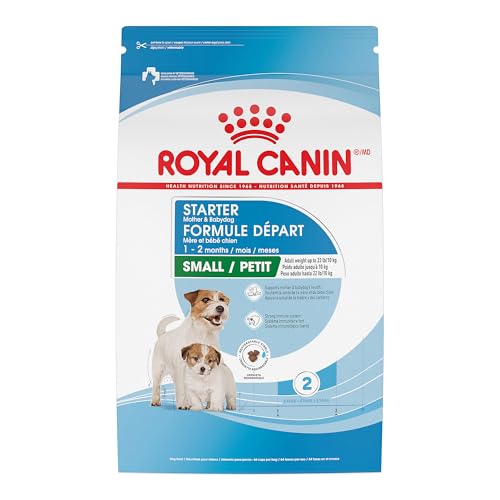 official product image via Amazon
Royal Canin · brand facts & recall history →
Royal Canin Small Starter Mother & Babydog Dry Dog Food
A formulated-to-meet, chicken-first dry food that's cheaper per calorie than 4% of the dry foods we've priced and denser than 49% (you feed fewer cups) — $5.05 a day for your 40-lb adult dog.
THE FACTS, ONE SENTENCE — data as JSON · reference dog 40 lb · updated 2026-10-18
The evidence
The Verified Label
Every food on this site gets this exact panel — same fields, same order, sourced from the official label — so brands finally become comparable. Dots show where this food sits among all 494 dry foods we've verified.
verified 2026-10-18
Composition — dry-matter basis
why dry matter
Calories & cost — for your 40-lb adult dog
Cost per 1,000 kcal: $5.13 — cheaper than 4% of the 360 dry foods we've priced (median $1.93). Serving math uses standard veterinary energy formulas — see the formula.
Standards & ingredients
what this means
why unknown
Safety
Source: official label source (official)· price: Amazon, 2026-10-18 · anchors: 494 verified dry dog foods (360 priced) · how to read this label
The fit
For your dog, specifically
Checked for a 40-lb adult with a sensitive stomach — the same published criteria our finder uses. Change your dog above and these update.
The source material
The full ingredient list
Every flag above is computed from this list. Why order is by pre-cooking weight, and how splitting bends it →
Chicken by-product meal, brewers rice, chicken fat, corn, wheat gluten, dried plain beet pulp, natural flavors, monocalcium phosphate, vegetable oil, sodium aluminosilicate, potassium chloride, fish oil, pea fiber, salt, taurine, fructooligosaccharides, choline chloride, calcium carbonate, hydrolyzed yeast, rice flour, marine microalgae oil, L-lysine, vitamins[DL-alpha tocopherol acetate (source of vitamin E), L-ascorbyl-2-polyphosphate (source of vitamin C), biotin, D-calcium pantothenate, vitamin A acetate, niacin supplement, folic acid, pyridoxine hydrochloride (vitamin B6), vitamin B12 supplement, thiamine mononitrate (vitamin B1), vitamin D3 supplement, riboflavin supplement], DL-methionine, marigold extract (Tagetes erecta L.), L-threonine, trace minerals[zinc proteinate, zinc oxide, manganese proteinate, ferrous sulfate, manganous oxide, copper sulfate, sodium selenite, calcium iodate, copper proteinate], carotene, rosemary extract, preserved with mixed tocopherols and citric acid
10 ingredients in this list are ones we hold sourced evidence on , and 1 of them is genuinely contested rather than merely unpopular online.
- Peas · ingredient 13ContestedA pulse (legume) used in many grain-free foods as a plant protein and carbohydrate source. Peas are central to an open FDA investigation, begun in July 2018, into a possible link between diets high in peas, other pulses, and potatoes and canine dilated cardiomyopathy (DCM); 93% of reported products contained peas and/or lentils.
- Beet Pulp · ingredient 6Well supportedThe fibrous material left after sugar is extracted from sugar beets, included as a moderately fermentable fiber source (commonly around 5 to 7.5% of the diet). Controlled feeding studies show it supports firm, good-quality stools and short-chain fatty acid production without impairing overall nutrient digestibility, so the 'cheap filler' characterization is not supported by the evidence.
- Fish oil (EPA + DHA omega-3) · ingredient 12Well supportedMarine-source omega-3 fatty acids (EPA and DHA) from fish oil. A randomized, double-blinded controlled trial (Roush 2010) found improved weight-bearing in dogs with osteoarthritis, and a 2022 meta-analysis identified clear clinical analgesic efficacy for omega-3-enriched diets and supplements.
- Rosemary extract · ingredient 29Well supportedA plant-derived natural antioxidant (active compounds carnosic acid and carnosol) used to slow fat oxidation, frequently chosen as an alternative to synthetic preservatives. It is an authorized food antioxidant in the EU (E 392); JECFA established a temporary acceptable daily intake for rosemary extract expressed as carnosic acid plus carnosol.
- Mixed tocopherols (natural vitamin E) · ingredient 30Well supportedA blend of vitamin E forms (alpha-, beta-, gamma-, delta-tocopherol) used as a natural-source antioxidant to slow fat rancidity, commonly chosen as an alternative to synthetic preservatives. EFSA concluded that tocopherol-rich extracts are safe for all animal species and the consumer and are efficacious antioxidants in feed.
- By-Product Meal (Meat / Poultry By-Product Meal) · ingredient 1NeutralA rendered concentrate made from clean, non-muscle parts of the carcass (organs, necks, feet, and similar), defined by AAFCO. It is more variable and lower-transparency than a named muscle meal, but it is not inherently unsafe or low-nutrition: controlled feeding trials in dogs report high protein digestibility (roughly 92-95%) for poultry by-product-based diets, and some by-product organs are nutrient-dense.
Nutritional twins
Cheaper close matches
Verified foods with a closely matching label at a meaningfully lower cost per 1,000 kcal.
Label-composition matches only: same species, form, and growth stage; same primary protein where both are known; grain-free preserved; protein within 4 points and fat within 4 points, and estimated carbs within 8 points, on a dry-matter basis. Not a medical or quality recommendation.
The maker
Who makes this — and how they back it up
The five questions the WSAVA nutrition guidelines tell you to ask a pet-food company. Every answer is sourced or marked as an undisclosed gap — never guessed. This is the "is it made competently?" axis that star-rating sites skip.
Owns/operates its own plants; Mars opened a new $450M Royal Canin factory in Lewisburg, Ohio in 2025 (confirmed via mars.com press release).
source →Official Royal Canin US page explicitly states board-certified veterinary nutritionists and PhD nutritionists on staff.
source →Ambiguous: Royal Canin's answer to WSAVA's feeding-trial question says 'nutrient profiles and/or feeding trials' and does not say which retail foods had AAFCO feeding trials. every one says 'formulated to meet the nutritional levels established by the AAFCO Dog Food Nutrient Profiles' and none carries an 'animal feeding tests' statement.
source →covers: ingredient testing, finished-product analysis; same page: NIRS ingredient checks and mycotoxin testing. Royal Canin US answers to WSAVA's questions.
source →195 PubMed papers (animal/pet filtered) list Royal Canin in an author address; we checked 195 and 189 really name the company. A floor, not a total.
source →Full company scorecard, sources, and every SKU we've verified for this brand: Royal Canin brand page →